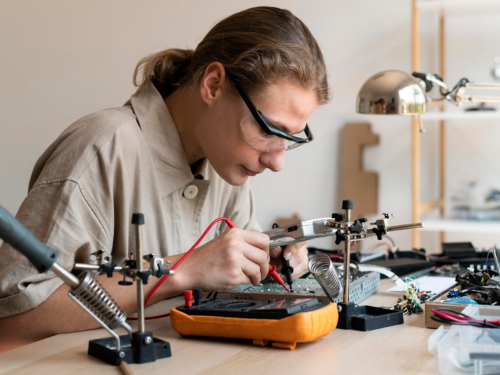
Robotics is no longer a niche domain reserved for engineers in aerospace or advanced manufacturing. It has become a core part of STEM teaching and research, embedded in everything from biomedical device prototyping to environmental science field robotics. As robotics programmes grow in both scope and complexity across higher education institutions, technical staff; particularly science technicians, are playing a central role in making these systems work, safely and reliably.
Supporting the Full Spectrum: From Arduino to Autonomous Systems
Modern robotics teaching environments span a huge range of platforms. On one end, there are microcontroller-based kits like Arduino, BBC micro:bit, and Raspberry Pi, ideal for teaching programming logic and simple electromechanics. At the other end, complex systems run on ROS2 (Robot Operating System 2), support real-time object detection through integrated vision systems, and even interact with industrial robotic arms or mobile platforms.
Science technicians are often the ones assembling, configuring, maintaining, and updating this diverse fleet of hardware. This includes ensuring safe power distribution, maintaining firmware consistency across robot fleets, and handling delicate calibration procedures, such as tuning servos, configuring inertial measurement units, and setting up machine vision pipelines.
Safety, Security, and Infrastructure Readiness
Unlike passive lab equipment, robots move, manipulate, and sometimes even learn. This introduces new safety and infrastructure challenges. Technicians must design spaces with adequate collision zones, emergency stop protocols, physical barriers, and power isolation.
Equally important are network segmentation and user account control. Robots that interface with campus Wi-Fi or departmental servers must be sandboxed to prevent unintended cross-traffic or malicious interference. Technicians are now responsible for provisioning student accounts with access controls, ensuring firmware isn’t accidentally overwritten, and setting up shared lab PCs with device drivers and ROS workspace management.
Simulation: A Teaching and Testing Revolution
As robotics becomes more mainstream in science and engineering curricula, there’s been a significant pedagogical shift toward simulation-based learning. Tools like Gazebo, Webots, Isaac Sim, and CoppeliaSim allow students to develop and test robotics code in a safe, visual environment, without risking damage to real hardware.
Technicians are crucial in this evolution. They provision and maintain GPU-equipped workstations, manage containerised simulation environments (often with Docker or Singularity), and set up version-controlled virtual worlds that match the physical lab setups. In many institutions, these same simulation environments are mirrored on cloud platforms for remote access, especially useful in hybrid or distance learning settings.
Simulation isn’t just a teaching tool, it mirrors how robotics development is done in industry. Whether it’s an autonomous warehouse robot or a robotic surgical arm, companies now prototype in simulation before deployment. By managing these pipelines in HE, science technicians are directly preparing students for industry-standard workflows.
Bridging Research and Teaching
Many university robotics labs double as research environments, working on grants related to assistive tech, swarm robotics, or field automation. Technicians working in these labs are responsible for keeping continuity between research-grade systems and student-facing resources, often translating cutting-edge setups into robust, scalable versions for undergrad labs.
This dual role means science technicians are frequently engaged in multi-disciplinary teams, contributing not just logistical support, but valuable insight into feasibility, safety, and performance.
The Technician as Robotics Enabler
The rise of robotics in HE is not just about curriculum expansion, it’s about technical enablement. Science technicians are now responsible for:
- Maintaining robotic hardware across diverse platforms.
- Configuring secure, student-ready computing environments.
- Managing simulation infrastructures that reflect real-world robotics workflows.
- Ensuring safety, scalability, and accessibility for all users.
In doing so, they are building the bridge between teaching, research, and real-world application—making robotics approachable, reproducible, and future-facing.